Ashlesha Nakshatra: Desires
Posted by Parisa Yazdi
2025-11-18
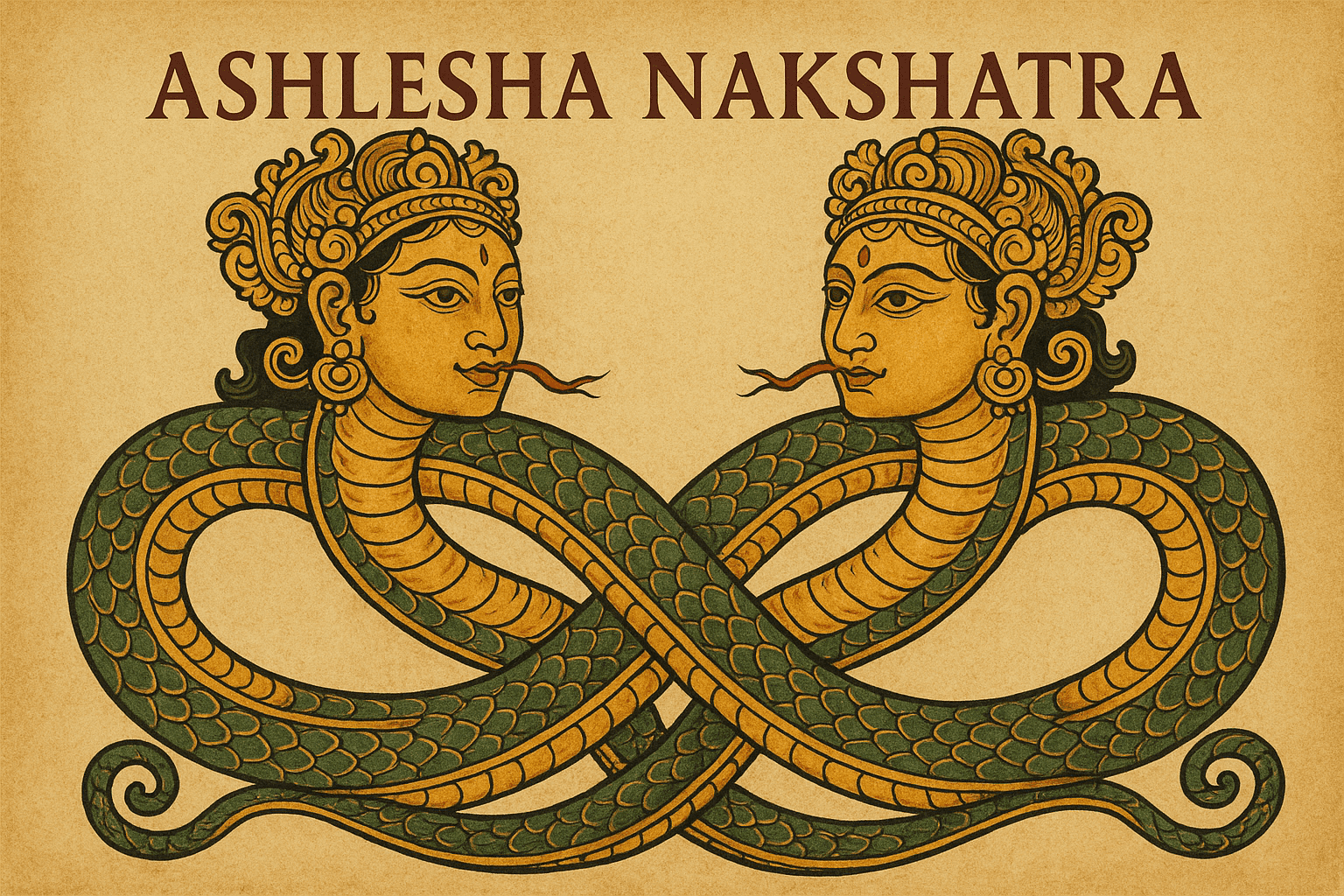
Ashlesha Nakshatra: Desire, Coiling, Magnetism, and the Intelligence of Connection
There is something unmistakable about Ashlesha. Even before we begin interpreting planets or transits, this nakshatra has a presence that enters the room long before the native does. It coils, draws in, surrounds, and binds. It is the serpent’s embrace that is both irresistible and unsettling. And to understand Ashlesha in any meaningful way, we have to step outside the surface-level caricature of “seduction” and return to the older narratives that shaped its symbolism in the first place.
Ashlesha’s deity is the Nagas, the subterranean serpent-beings who dwell beneath the Earth. In the Vedic imagination they are not simply snakes. They are a fallen class of beings driven by longing. They once occupied the higher realms among the devas, but were exiled to live below. That exile is the seed of the nakshatra. It is the place inside us that longs for what is no longer within reach. It is the intensity of desire that arises when something has been taken away. It is the magnetism that forms when longing accumulates in the body and seeks contact, connection, or consumption as a way to resolve itself. This is why Ashlesha’s desire is not mild or polite. It wants to merge. It wants to take in. It wants to coil.
When we borrow from these mythic layers, Ashlesha becomes less about “seduction” and more about the existential force of wanting. Anyone in exile knows the depth of longing. The nakshatra expresses that longing through attraction, charisma, charm, and the instinct to pull the world closer. The serpent’s coil is not a casual embrace. It binds. It encircles. It penetrates. It entwines itself with the object of its desire in a way that evokes intensity rather than moderation.
This is where the polarity of Ashlesha begins. In its higher expression, the coiling is devotion. It is the ability to hold someone with depth and presence. It is the power to create intimacy and passion. It is loyalty, protection, and the fullness of being “wrapped into.” When moderated, Ashlesha creates lovers, artists, diplomats, and charismatic figures who can speak, move, and act with a hypnotic quality that inspires connection in others. In its best form, Ashlesha deepens union rather than destabilizing it.
But when the desire becomes unregulated, the same coil tightens into control. The passion becomes suffocation. The longing becomes jealousy or obsession. The charisma becomes manipulation. The nakshatra contains both potentials because both are inherent to desire. Every longing can nourish or devour, depending on what drives it and how it is handled.
Mercury in Ashlesha is particularly complex. Mercury is the planet that creates relationality. It closes the distance between point A and point B. It reads the room, mirrors the other person, adapts, and creates rapport. Mercury makes connection possible. When placed in a nakshatra that already wants to draw things into itself, Mercury becomes a powerful tool. Here, intelligence is relational intelligence. Speech becomes a means of attraction. Communication becomes a form of coiling. The native learns how to speak in a way that enters the other person’s internal world.
This is why Mercury in Ashlesha can mimic, adapt, and shape-shift. It is a chameleon quality that arises not from duplicity but from the instinct to connect. When the intention is clean, it creates incredible diplomacy, persuasion, and charisma. When the intention is driven by unregulated desire, it can drift into exaggeration, bending the truth, or using speech to lure others into their orbit.
Other planets produce equally striking variations. Venus or Mars intensify the sensuality and passion. The Moon magnifies desire, sensitivity, charm, and insecurity. Saturn introduces dispassion, restraint, and a sense of feeling cut off from the very powers Ashlesha is known for. The Sun emphasizes authority, ego, and control, rather than seduction. Each planet expresses a different facet of the serpent.
The houses also matter. In the seventh house, the longing or coiling may appear through relationships. In the fifth, it may try to attract romance or admiration. In the twelfth, the entire impulse turns devotional, because there is nothing material left to coil around. The nakshatra then begins to bind itself to the divine.
What remains consistent across all placements is the internal architecture: desire, longing, magnetism, charisma, connection, and the capacity to entwine with what is sought. Ashlesha reveals something essential about the nature of wanting. It teaches us that desire is powerful, creative, destructive, and transformative. It is an engine that can bind us to others or bind us to truth. It can create intimacy or illusion. It can enrich life or derail it. But it always reveals where the longing comes from and what we believe will satisfy it.
The serpent does not act without reason. It moves with intention. Ashlesha asks us to examine the nature of our own intentions, our desires, and the ways we coil around the people, ideas, and experiences we reach for. It demands honesty about what drives our magnetism, what fuels our longing, and what we are truly trying to pull toward ourselves.
At its best, Ashlesha is not seductive. It is devotional. It coils not to consume, but to unite. It binds not to control, but to offer the fullness of its intensity to what it loves. And when Mercury transits this nakshatra, that intelligence becomes more conscious. We begin to see the mechanics of desire with clarity. We begin to understand the discernment required to use magnetism without distortion. And we begin to recognize that the serpent is not here to deceive, but to reveal something deeper about the heart of our longing.